Ride Punch Float

Running is really a beautiful thing when you break it down to its core elements. It’s a circuital process made of up of three distinct phases. The ride, the punch and the float. The more these contrast at their peaks but blend at their transitions, the more efficient the stride. Energy storage, a brief moment of violent impulse, and then relaxation.


First, the body must ride with external forces. It cannot fight gravity, it must succumb to the ride it is taking you on. The more it tries to resist the more this inertial slingshot works against you.

Give in.  Let yourself fall.  


The more rushed we are to get through the ride, the less the load is shared. An increase in the loading rate drives a greater shock to our system. It drives a choppy impact pack, a quick slam on the brakes. Potential energy converted to misdirected kinetic energy. Don’t rush the punch, let the orchestra arrive on the same note. However, if delayed too long the chance is missed, the wave crashes before you can hop on. If missed you must work harder to overcome the loss of free energy with the punch. 

The punch is where the accrued energy of the external forces are cashed in. Where patience and timed action are rewarded. When the rubber band is pulled back the work is all but done. All we must do is simply release. The punch is subtle but firm. Blink and you’ll miss it. The stored energy from the environment charges the internal structures. They expand – only to recoil with a domino-esque temporal rhythm. The wave builds and crashes with an effortless and eloquent violence. This is the moment of maximum propulsion, the active peak. Maximum compression of the system leading to the highest force applied to the ground and maximum internal forces applied to other internal tissues. 


The punch is followed by the float. An immediate recoil. Retreat and reload. Relax and expand. As fast as your internal forces acted on the external world they must now relax again and be passive. By relaxing you cash in your hard work and reach max velocity. It’s an earned vacation. Short lived though it may be, it is an effortless flight where any added effort will only subdue the earned result. 


The characteristics of these three phases must match the signature of the individual. This orchestra must meet the demand of the task. The tempo must be fitting for the song being played. The style must also meet the abilities of the orchestra. Too fast for an unequipped drummer and the piece will be unsustainable. Too long of a note held and the gifts of the external world are wasted. It’s playing to your strengths while finding ways to mitigate any weaknesses. Its identifying weak points and finding subtle changes. It’s about learning to submit to the forces acting upon. To use it as fuel right up until the wick reaches the fuse.


Work with, not against. 


ride, punch, float
ride, punch, float

– Anthony
Amara’s Law and Behavior Change

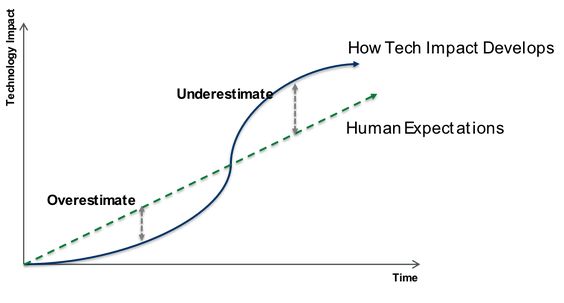
Roy Amara, a Stanford computer scientist and Head of the Institute of the Future posed a keen observation. He stated that we tend to overestimate the effects of new technology in the short term, but underestimate it in the long run. A great example here is computers. Those who originally set out to make “thinking machines” and the science fiction that followed overestimated the initial effects that computers would have on society as the experts and computers sat isolated in rooms. Despite the short term miss on expectations these initial estimations have undershot the world changing direct and tertiary effects that computers do and will continue to have on our lives. 

Sudha Jamthe on Twitter: "Speaker of @StanfordCSP "self-driving cars  business" @anupamr Amara's law shows human expectation vs technology  capability for emerging tech. AV is in the overestimated phase vs  expectations #driverless… https://t.co/IJaiPvUlWG"
We expect progress to be linear where more often than not a “trip wire” effect occurs. The compounding effects creates an exponential rise once a certain threshold is breached. Figure from Sudha Jamthe on Twitter.


When it comes to behavioral change, new habit implementation seems to follow Amara’s law. We expect progress now, or at least expect it to be linear. We see the promise of the end road and mentally are committing to an expedited process. An optimists projection of time til returns. 


We tend to expect that first few week of exercise to create some sort of physical or mental phase shift other than just making us sore and tired. Though often, those first few weeks just make it more unpleasant to walk up the stairs. Logically, we know striking gold on the first round is highly improbable, but emotionally we need consistent signs of progress to continue to comply with the inconvenient and uncomfortable challenges we add to our life. 


On the other hand, we often greatly underestimate the change that these small scale habits can have on our live on the scale of years. We undervalue the impact of a daily walk on our physical and mental health. We don’t appreciate how the commitment to 30 minutes of resistance training, twice a week can profoundly lessen our risk for many common diseases. What we don’t see is that once we hit a certain threshold of fitness, each stair we climb is a percent less taxing on our body. Accrued over a day we are exponentially more efficient. A trip wire exists right over the horizon that will provide 100x returns on investment rather than the consistent payments you thought you would receive. It’s hard to commit to because the act often feels too easy to create such staggering effects future effects and feels justified for not creating instant returns.


 The lesson here. Guide your clients to commit to small. To commit to playing the long term games. Find quick wins to paint a picture of the end game potential but foster patience. Cultivate a dedication to the process. 


What are you undervaluing today that could drastically change your world in 10 years?

-Anthony

The Chance vs. Certainty Conundrum

The fickle seduction of chance vs the vain certainty of science.

These polar viewpoints are illustrated in the 16th century woodcut depicted below and described eloquently by Gerd Gigerenzer in his book, Risk Savvy.

Certainty Is an Illusion
Fortuna (left) sits with her spinning wheel of chance opposed to Sapienta (right) vainly staring into the mirror of certainty. Source: Risk Savvy: How to Make Good Decisions

Fortuna, the blind folded goddess holds the spinning wheel of chance. Her eyes, covered as luck drives the outcome and one man rises on the wheel and the other falls. 

Sapienta gazes upon herself in a mirror designed with icons of the cosmos. She represents the certainty hubris of scientific determinism. She looks down on Fortuna as primitive and careless. Fortuna ignores the existence of Sapienta, caught in the thrill of the spinning wheel. 

This piece was created a century before the probabilistic revolution, One of the greatest mile markers in our societies collective problem solving journey. Probability added a goddess who could tend to the middle ground. A rational center removing the blind fold of chance from Fortuna and shining the true reflection of uncertainty back at Sapienta. 

We continue to wrestle with this polarity. Uncertainty is uncomfortable and can drive us to align with one of these two goddesses. It easier to throw up your hands and give away control to fate. To take a nihilistic renouncement of responsibility. It’s easy as well to cling to the “knowns”. To take the “you can pry the p values from my cold dead hands” approach. 

Failure to wade in the middle leaves us vulnerable to bad decision making. Good decision making requires putting down the mirror and removing the blindfold. It requires the knowledge to define the knowns variables and the humility to highlight the unknowns.

To wade in the turning tides of uncertainty.

-Anthony

To Your Failure


Failure is essential.

Just as a baby must fall to receive instant and vital feedback, so must we. A recent study by Wilson, et al. suggests that optimal learning occurs with around an 85% success rate. This “Goldilocks zone” suggests that an optimal learning environment must force us to fail enough of the time. Acting fast and finding that 15% allows us to improve more readily.

This is somewhat intuitive. But then why do we then so often shelter ourselves and our clients away from failure?

Rather we must celebrate the 15% as it vital to progress. Each missed rep is fuel for better. 


 So to those like me who lived in the 3 point something GPA world of a solid B’s, a tip of the cap to you!

To your failure,


Anthony 

The Joy of Finding Nothing

We are taught to pick out the issue and highlight it. 

Seek and destroy. 


What happens when nothing appears? Do we cultivate something to soothe our need to be needed? Look hard enough and you will find something.

But ask yourself,  “how likely is that to be a considerable variable in this equation?”. Is there something more likely that has or is occurring that does not really require my continued skillset and intervention? 


This is uncomfortable at first.


 But see the value in clearing more insidious issues. The importance In giving the person permission to intelligently continue. The joy In finding nothing. 


Consultant first, therapist second. 

– Anthony

Where Does Your Problem Live?


Problems come in levels.

They come with knowns and unknowns.

Predictability and uncertainty.

Certainly, not all are created equal. The decision to have chicken or salmon for dinner carries less weight than which college to attend. 

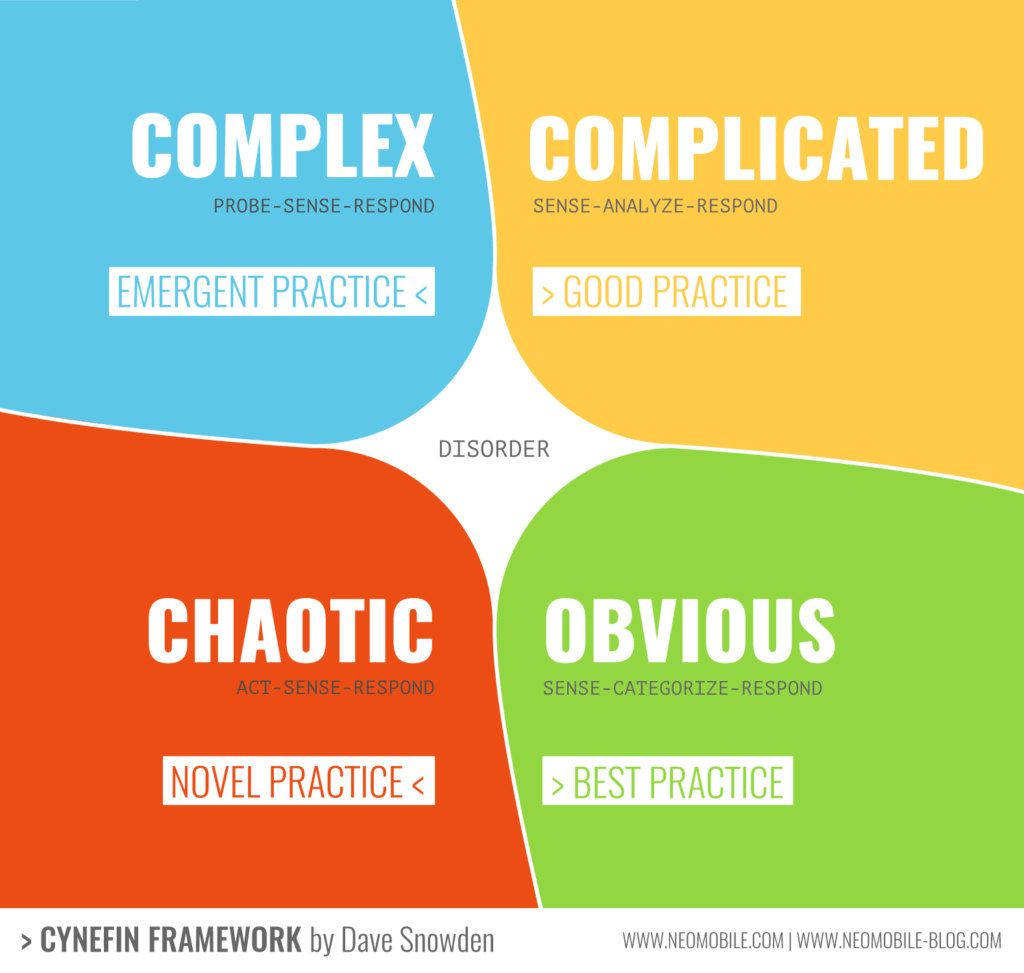
Do you know what realm the one you are tackling lives on? Defining this allows us to pick the right set of tools from our arsenal to manage the problem.Dave Snowden,  a researcher in the field of knowledge management and the application of complexity science, developed a sense making tool called the Cynephin framework.

Cynefin, Klay and KD • ALTIS

Cynephin is a Welsh word for Habitat. Snowden broke problems into 4 domains. Simple, Complicated, Complex, and Chaotic. The borders between these are made formed through what can and cannot be know before the fact. 


Simple is the realm of known-knowns. We have established reproducible data forming  “laws” that can guide our decision. Thus there is established best practice. Thus we can sense the state of the problem, categorize it, and then respond based on these best practices. 


Complicated is the realm of known-unknowns. We may not have all the data ourselves, but we are still working within an ordered and predictable system where the right person with the right knowledge (content expert) can surmise an answer. I know nothing about what may go wrong with a car engine but a mechanic can draw a direct cause and effect. Thus the tactic here require sensing the problem (car is rattling), analyze (take the car to an expert), and respond (tighten a screw, add oil etc..)


With a complex problem we are wading in the unknown-unknowns. Here the system is disordered and unstable. Answers live in flux as small changes can have dramatic changes on an outcome. The answers here, live only in the post-hoc analysis. Think of the weather here,  though we have sophisticated algorithms, accurate predictability is limited until the day of as small shifts in the data creates a meaningful change in the outcome. Tactically, we must first probe the system to gain more data. Apply a perturbation to see “how the defense shifts”. We next can attempt to sense an emergent pattern. We then can respond. Think here of waking up with a painful low back with no clear reason. I try to bend forward (OUCH!). I twist (OUCH!). I lay on my stomach and bend back (probe) (Ou….Ahhh). A pattern of symptom relief from extension has emerged (sense). This allows me to respond with amplifying extension and dampening flexion until a new pattern emerges (respond). This could only be known post-experiment. 


Chaos is the realm on unknowable unknowns. This is a high turbulence temporary state. The situation needs to be first stabilized. This is a plane crash, a heart attack triage. This is not the time for seeking for causation. We act first (perform CPR), then sense (perform tests), and respond (surgery/medicine/rehab).  


The domain drives the tactic. Viewing a complex scenario as simple or complicated can lead to do false confidence and lead us susceptible to miss possible solutions. Viewing a simple problem a complex leads to overthinking. 


Before you decide- take a moment to understand the habitat you are operating in before reaching into the tool box. 

-Anthony

Speak Their Language

“Take things as they are. Punch when you need to punch. Kick when you need to kick” – Bruce Lee 


What is your primary clinical language? 


Where does your comfort lie? 


Barbells? Pain science education? Yoga? Manual Therapy? Running?


If we are more proficient and comfortable in a certain language we are certainly prone to speak it more, even if the one on the receiving end is only partially fluent. It’s only natural to deviate towards your experiences. Your comfort zone. We all do it, and there are certainly advantages at times to playing to your strengths. 


However, how close can we get to speaking their language?


Can our initial encounter flush out what it is? Can we adapt our intervention and communication menu to meet them at their strengths?

This is the power of a generalist. To use their methods to solve the problem rather than being constrained to the comfort of only your own. If we look wide and understand the essentials of what we are intending to do our tool box becomes wide. If the patient knows how to kick. We solve the problem with a kick variation. A punch? A punch variation. 


When we do this we stop fighting and we begin collaborating. We take away the pre-requisite requirement for them to learn another language. The patient is not asked to swim upstream and the clinician has the chance to become more variable. Play the role they need you to play. Be their translator.

-Anthony

5 Questions

With any new patient interaction there are always elephants in the room. ⁠

Expectations⁠

Emotions⁠

Past experiences⁠

These create noise. ⁠

These unspoken preconceptions (from both parties) muffle the communication interplay. ⁠

As the guide for the encounter, your role is to wade through the noise and identify and address the cornerstone concerns. ⁠

Answering these 5 questions often casts a wide enough net to wrangle up most of the loitering elephants. ⁠

  1. What’s wrong with me⁠
  2. What can you do to help?⁠
  3. What can I do to help? ⁠
  4. How long will this take? ⁠
  5. What are my options If this doesn’t help? ⁠

    Do not mistake the need to address these questions with the need to provide answers or certainty. Simply provide possibilities and perspective. Follow up with actionable steps and check point for follow up. ⁠

    Interaction example: ⁠

    “Mrs. Smith based off of our conversation and assessment your issue is likely being driven by some combination of A, B, and C. This is a normal process and certainly something our bodies can adapt and heal from. We are going to try D, E, and F first. We will do D and E together here and I would like you to really focus on F at home. In 2-3 weeks we will re-assess and adapt based on how things are going. If things are not moving in the direction we would like in 6-8 weeks I will likely recommend X” ⁠


⁠- Anthony

The Middle Ground

We love the perception of hard. 


We avoid actually hard. 


 Low and easy never feels like we are doing enough so we ramp it up just a little to feel like we are “doing something meaningful”. 


These roads lead us to the middle ground and the middle ground is where progress goes to die.  The perception of what we are doing typically wins. Busy, tired, sore are all side-effects, not outcomes. We wear them like a badge of honor. An “I voted today” sticker to acknowledge that you are doing something to take you somewhere.
 

But busy, tired, and sore are terrible mile markers. They are false proxies for positive adaptation and change. 

Ask: “Is this doing what I intend it to do?”, “Am I doing this just to do it?” 

Is that single leg single arm rotational kb snatch to step up thingamajig really doing something or does it just look like it is? 

Is that same 5 mile run at the same moderate intensity pushing the needle anywhere? 

Is your churning away at emails and social media all day creating value or just the perception of busy? 

Whether with our client or our own growth- we are stress allocators.

This is our medicine.

Dose appropriately.

Then rest. 
*Stress + Rest = Growth. 

*But be sure to make your stress stressful and your rest is restful. 

– Anthony